
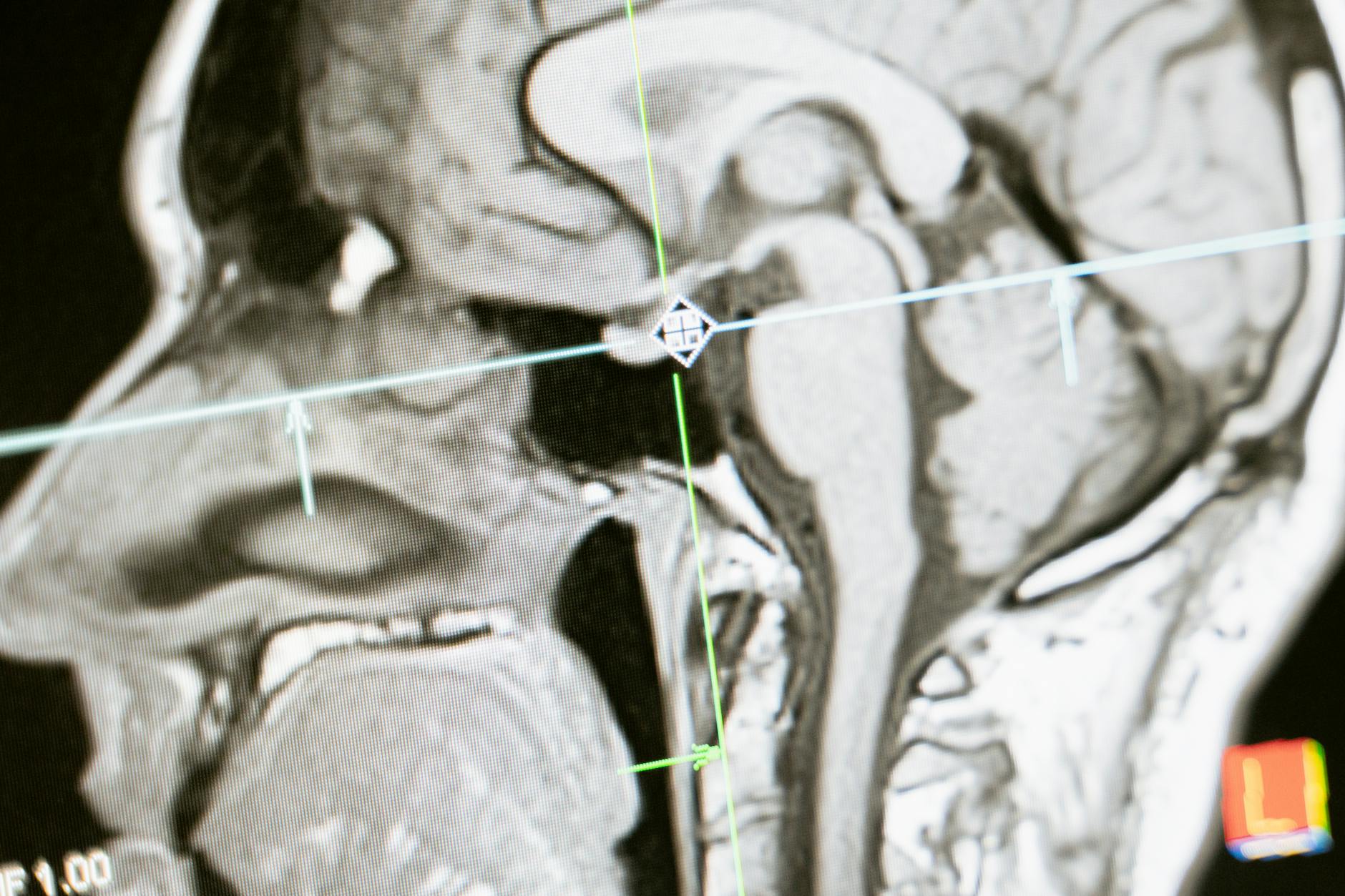
The pituitary gland is one of the most consequential organs in the human body, despite sitting in a cavity at the base of your skull no bigger than a garden pea. It weighs less than one gram. It produces at least nine distinct hormones. And without it functioning correctly, almost every other gland in your body stops receiving the signals it needs to do its job. If the thyroid, adrenal glands, and reproductive organs are the workers, the pituitary gland is the site foreman sending out the orders.
Where the pituitary gland sits and what it looks like
The pituitary gland sits in a small bony hollow called the sella turcica, nestled at the base of the brain, directly beneath the hypothalamus. It's connected to the hypothalamus by a thin stalk of tissue called the infundibulum. That physical connection matters enormously: the hypothalamus monitors conditions across the body and sends chemical instructions down the stalk, telling the pituitary what to release and when.
The gland has two distinct lobes: the anterior pituitary (adenohypophysis) and the posterior pituitary (neurohypophysis). They look similar from the outside but function quite differently. The anterior lobe manufactures its own hormones in response to hypothalamic signals. The posterior lobe doesn't produce hormones itself. It stores and releases two hormones made by the hypothalamus, oxytocin and antidiuretic hormone (ADH), and delivers them into the bloodstream when needed.
What the anterior pituitary produces
The anterior lobe is responsible for the majority of the pituitary's hormonal output. It produces six major hormones, each targeting a specific tissue or gland elsewhere in the body.
- Growth hormone (GH): stimulates growth in bones and muscles and regulates metabolism throughout life, not just during childhood.
- Thyroid-stimulating hormone (TSH): tells the thyroid gland to produce thyroxine, the hormone that controls metabolic rate. When TSH is low, the thyroid slows down.
- Adrenocorticotropic hormone (ACTH): signals the adrenal glands to release cortisol. During a physical or psychological stressor, ACTH levels spike almost immediately.
- Follicle-stimulating hormone (FSH) and luteinising hormone (LH): both govern the reproductive system, controlling the menstrual cycle in women and testosterone production and sperm development in men.
- Prolactin: drives milk production in breastfeeding women and also plays a role in immune function and metabolism.
Each of these hormones targets a downstream gland or tissue, which then produces its own hormones. The pituitary doesn't just issue commands once. It monitors feedback constantly. If the thyroid produces too much thyroxine, the signal travels back and the pituitary reduces its TSH output. This feedback loop keeps the system in balance.
What the posterior pituitary releases
The posterior lobe releases two hormones made upstream in the hypothalamus. Oxytocin is widely known for its role in bonding and childbirth, but it also drives uterine contractions during labour and milk ejection during breastfeeding. The popular science version of oxytocin is incomplete; it's a far more precise physiological messenger than the "love hormone" label suggests.
Antidiuretic hormone (ADH), also called vasopressin, controls how much water the kidneys retain. When ADH levels drop too low, the kidneys can't concentrate urine properly, and the body loses water rapidly. This is what happens in a condition called diabetes insipidus, which is unrelated to the more common diabetes mellitus despite sharing a name. ADH also causes blood vessels to constrict, which raises blood pressure during fluid loss.
What goes wrong when the pituitary malfunctions
Pituitary disorders fall into two broad categories: too much hormone output (hyperpituitarism) or too little (hypopituitarism). Both can cause serious, wide-ranging problems because the pituitary's reach extends to so many systems simultaneously.
Pituitary adenomas are benign tumours that grow in the gland itself. They're more common than most people realise. Studies suggest that small, clinically silent adenomas are present in roughly 10 to 20 per cent of the general population, though most never cause symptoms. When adenomas do become active, the consequences depend on which cell type is involved. A prolactinoma, the most common type, overproduces prolactin, causing irregular periods, infertility, and unexpected milk production in both sexes. An ACTH-secreting adenoma causes Cushing's disease, flooding the body with cortisol and producing weight gain around the trunk, muscle weakness, and stretch marks. A GH-secreting adenoma in adults causes acromegaly: gradual enlargement of the hands, feet, and facial features over years.
Hypopituitarism, where the gland produces too little of one or more hormones, can result from tumours compressing healthy tissue, radiation treatment, traumatic brain injury, or autoimmune attack. Because the pituitary governs the adrenal glands, a severe case can leave the body unable to mount a stress response, which is a medical emergency. The connection between pituitary failure and adrenal gland function is one of the clearest examples of how tightly linked the endocrine system really is.
How the pituitary is diagnosed and treated
Most pituitary disorders are detected through a combination of blood tests measuring hormone levels and MRI imaging of the brain. An MRI can resolve adenomas as small as 2 to 3 millimetres with modern scanners, though very small microadenomas can still be missed on a first pass.
Treatment depends entirely on the specific problem. Prolactinomas often respond well to a class of drugs called dopamine agonists, most commonly cabergoline, which shrinks the tumour and normalises prolactin without surgery. Other adenomas may require transsphenoidal surgery, where a neurosurgeon accesses the gland through a small incision inside the nostril, avoiding open brain surgery entirely. Radiation is used in cases where surgery doesn't achieve full removal.
Hypopituitarism is managed with hormone replacement targeting whichever axes have failed. Cortisol replacement is the most urgent, since adrenal insufficiency can be life-threatening. Growth hormone replacement is used in both children and adults, though the indications and benefits in adults are more nuanced than in paediatric patients.
The pituitary's relationship with the hypothalamus
It's impossible to understand the pituitary in isolation. The hypothalamus sits directly above it and acts as the brain's endocrine translator, converting signals from the nervous system into hormonal commands. When you experience chronic stress, the hypothalamus releases corticotropin-releasing hormone (CRH), which tells the pituitary to release ACTH, which tells the adrenals to produce cortisol. That cascade runs continuously, and when stress is sustained rather than brief, it pushes cortisol output into ranges that damage tissue over time. Understanding how chronic stress changes cortisol output starts with understanding the hypothalamic-pituitary-adrenal axis, the feedback loop connecting all three organs.
The pituitary also integrates signals from light exposure, temperature, sleep, and metabolic state via the hypothalamus. It doesn't operate on a fixed schedule; it responds continuously to what the body reports is happening. That's what makes it so central, and so vulnerable when things go wrong upstream.
Why most people never think about it
The pituitary gland rarely comes up in everyday health conversations, partly because its failures are often gradual and mimic other conditions. Fatigue, weight changes, mood shifts, and reproductive irregularities are common enough that many Australians live with a pituitary disorder for years before anyone investigates the gland itself. The Pituitary Foundation Australia notes that diagnosis delays of three to five years are not unusual for conditions like acromegaly, partly because early symptoms are subtle and partly because GPs don't always order the right blood tests first.
Its size makes it easy to underestimate. One gram of tissue, sitting quietly in a hollow at the base of the skull, sending signals that govern growth, reproduction, metabolism, stress response, and fluid balance simultaneously. No other structure in the body coordinates so many systems from such a small footprint.